Active Voice Vs. Passive Voice - What's the Difference?

“Verbs are the most important of all your tools. They push the sentence forward and give it momentum. Active verbs push hard; passive verbs tug fitfully.”
- William Zinsser
In the world of copywriting and content production, it’s likely that you’ve heard the phrase active voice. If you have, then you’ve probably also heard the phrase passive voice.
But between active voice and passive voice - which one is better? Which one should you be using? And how do you know the best way to apply each style?
Well, let’s jump right in.
Now - I will start by saying this: if you want your writing to be more engaging, more interesting, and more punchy - you should generally be using active voice.
So what is active voice? Well, it's when the subject of your sentence performs an action, expressed through a verb: “I threw the ball.”
The opposite of active voice is passive voice. This is when the subject undergoes the action of the verb: “The ball was thrown by me.”
Both sentences are saying the same thing, and they’re both describing an event in the past tense.
But active voice is more direct, more energetic - and engages the reader with the action:
“I threw the ball.” sounds like it just happened. And it’s easy to picture it in your mind.
Passive voice is less direct and sounds much more ambiguous:
“The ball was thrown by me.” When? Just now? Yesterday? Two weeks ago? It might have just happened - but it doesn’t really sound like it.
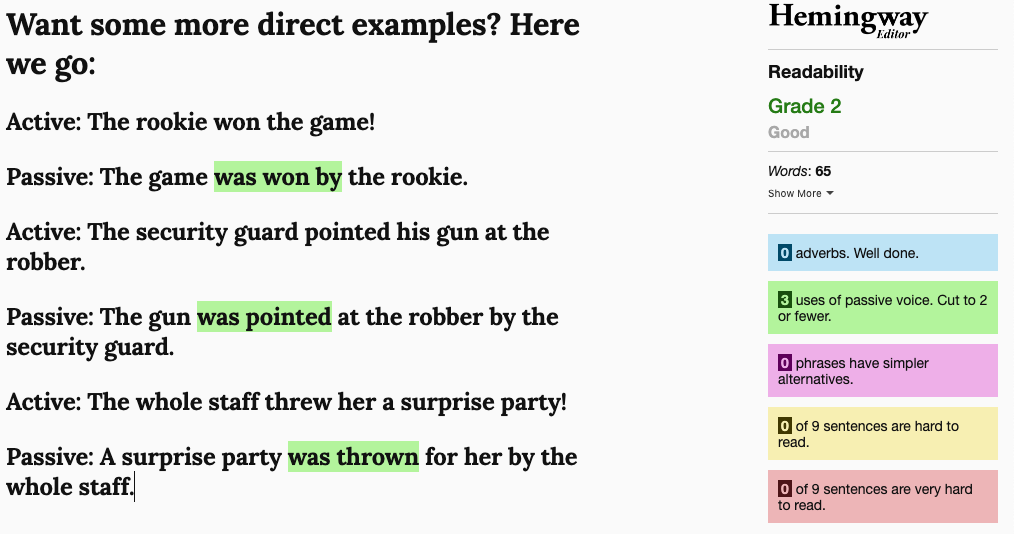
Want more direct examples? Check these out.
Active: The rookie won the game!
Passive: The game was won by the rookie.
Active: The shaking bank manager pointed his gun at the robber.
Passive: A gun was pointed at the robber by the shaking bank manager
Active: The whole team threw her a surprise party!
Passive: A surprise party was thrown for her by the whole team.
I like to think of active voice as putting your writing “on the front foot.” It adds more energy, it’s easier to understand, and it generally uses fewer words. Plus - it brings your readers along for the ride.
Take a look at Nike's world-famous slogan written in passive voice:

Image sourced from Business 2 Community (Check it out - it’s a great blog post!)
Not quite as effective is it? The oomph is gone, and it sounds deflated. Plus it’s WAY too wordy.
Let’s be honest - it’s downright awful.
If you’re writing slogans or advertising copy aiming to encourage energy and action - active voice is the best way to go.
Is there a place for passive voice?
Of course. Apologetic celebrities and politicians have been using it forever.
Precisely because passive voice is less direct, it can be an effective way to deflect blame in an ambiguous way.
“I made a mistake.”
“Mistakes were made.”