Why I Don't Write With AI (And Never Will)
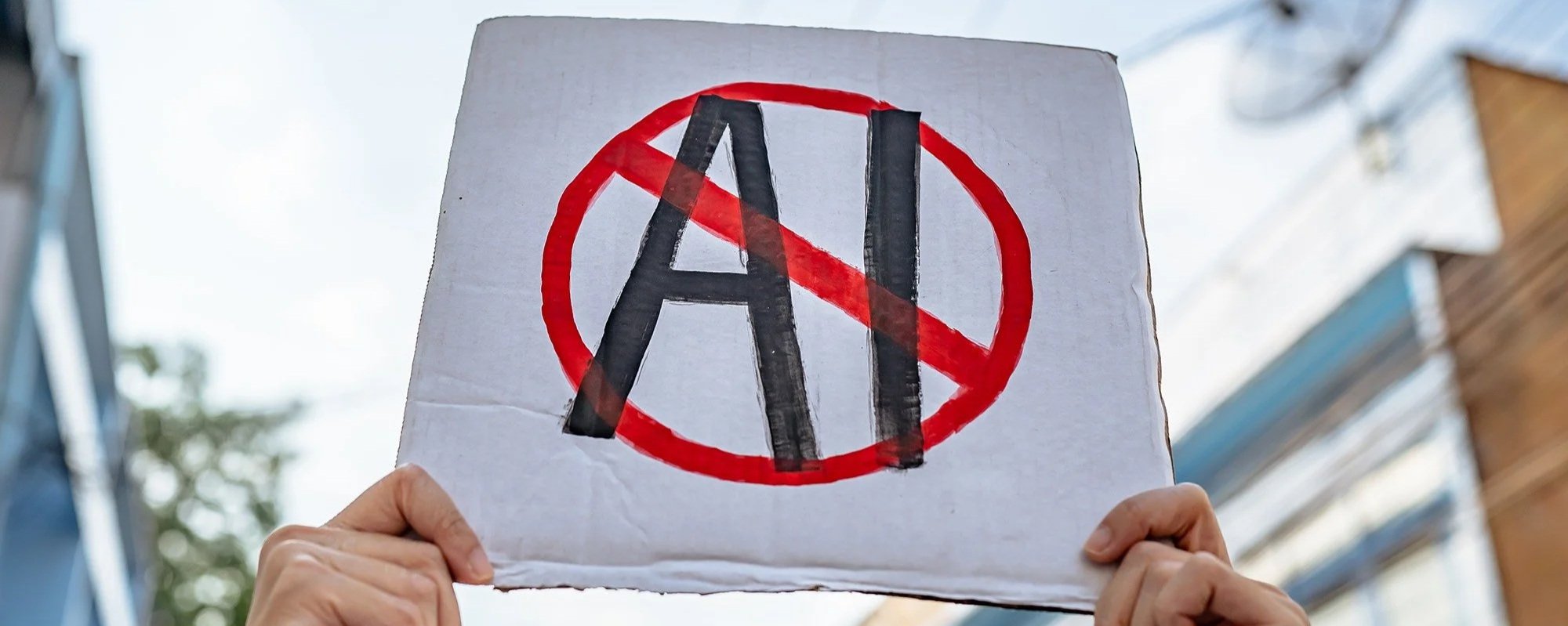
Image source: otakuusamagazine.com
Many people are surprised to discover that I don’t use any form of AI in my copywriting work. That’s because the human element isn’t just vital to building meaningful connections – it’s the core of what makes reading anything worthwhile.
(Speaking of which, the reading time is approximately 10 minutes)
Well, it’s been almost three years since my last blog post (I’ve been flat out writing!), so I thought it was about time I addressed the eight-trillion-dollar digital gorilla that’s been stomping about the room and breaking all of mum’s valuable china.
As a professional freelance copywriter, the explosion of AI chatbots like ChatGPT created a direct competition to my livelihood. After all, they can bang out an entire essay in seconds, something that will take even a very skilled writer several hours, if not days (I’ve been working on this blog post, on and off, for about three weeks).
For the last three years or so, whenever I’ve met someone at a party or coworking space and tell them what I do for a crust, they invariably ask one of two questions: ‘Do you write everything with ChatGPT now?’ or ‘Aren’t you worried that ChatGPT will take your job?’
They’re generally surprised when I answer both questions with a ‘no’ and a smile.
The fact is, I don’t use AI in any of my writing work, nor do I ever want to. And this may surprise you, but not only has AI not reduced the demand for my copywriting and editing services, but I’ve never been busier (hence my lack of blog updates). In fact, many people have sought me out because I don’t use AI. My writing is, and always will be, the product of a human mind drawing from real-world knowledge and experience in renewable energy, cleantech, and sustainability.
And being as AI has also been relentlessly rammed down our collective throats for several years now, I wanted to articulate exactly why I don’t use it. So here it goes.
Writing is and must be, by nature, a reciprocal exchange
AI’s meteoric proliferation has unearthed some interesting truths we’ve never really had to reckon with before. For all of human history until just a couple of years ago, whenever you read something – from a 1,200-page novel to a 25-word news headline – you were taking part in an implicit cognitive exchange. The author had to invest their time, effort, and skill to write it, and in turn, you had to do the same to read and understand it.
AI completely skews this paradigm. For example, if you generate an article with ChatGPT, you haven’t put in any of the necessary time and effort to create it (or collaborated with a person who can), but you still expect the reader to uphold their end of the bargain.
See where I’m going with this? It’s the simple reason why so many people don’t want to read AI-generated content, and will tune out the millisecond they realise the words they’re reading are not of a human mind. It’s exactly the same with crappy AI-generated art: why would I want to come to your event or eat in your restaurant (i.e., give you my time and money) when your promotional material is just AI slop that required no effort? Again, just like using AI to pump out banal articles, you can’t expect meaningful engagement if you’re not willing to give any of your own.

‘Oh I’m sorry, did you think your friend was coming to dinner? She’s hanging out with much more important people – but I can sit here and take notes if you want to eat by yourself.’ – This is how I feel when I read something written by AI.
This all reminds me of a trope I’ve seen in a bunch of TV shows (Brooklyn Nine Nine springs to mind), where one of the main characters suddenly becomes successful and/or famous, catapulting them into an elite social sphere. They’re quick to claim nothing will change, but before long they’re due to meet a friend for coffee or dinner, and instead of showing up in person, they send a (typically stressed-out) assistant as a proxy.
The friend, naturally, is dejected that they’re no longer a priority, and it creates a big rift in their relationship. Then, at the end of the episode, the successful friend either loses or relinquishes their newfound status, restoring the previous balance and teaching us all a valuable lesson.
And what is that lesson? It’s that all meaningful human interaction is, by definition, reciprocal. If you want to resonate with your audience – really talk to them – you have to be willing to put in the work, and you have to hold up your end of the bargain. Otherwise, your reader is just someone sitting opposite a stranger at dinner, wondering why they bothered showing up.
AI was built on the largest IP theft in human history
On purely ethical grounds, I can't (and don’t want to) support a technology that has so shamelessly stolen from me and millions of people like me. And I’m not just talking about writers, but visual artists, actors, filmmakers, and even musicians. You know, basically anyone who’s ever made anything creative, ever. This is not necessarily anything new in the tech world – companies like Apple, Google, and Meta have been hoovering our data for years – but somewhere along the line, enough is enough.
To build their LLMs, companies like Open AI and Meta ‘scraped’ (read: stole) unfathomable swathes of text from across the internet – from inane BuzzFeed listicles and old Perez Hilton blog posts to medical records and sensitive details about children to 82 TB of illegally pirated books and academic papers – without ever asking permission or offering a single red cent of financial recompense.
This strategy was entirely deliberate: the tech companies were confident that by doing so, they would quickly amass so much money and power that by the time anyone realised what had happened, it would be far too late. Sadly, they were mostly right.
Now, scores of newspapers and publishers are taking companies like OpenAI and Microsoft to court to try and claw back a fraction of their lost revenue, but these trials will likely be tied up in the legal system for years. For freelancers like me, as is generally the case, there’s virtually no way I’ll ever see justice or fair compensation for the work that was stolen from me without my knowledge or permission.
So, to that end, using AI to write feels like a kind of betrayal – not just to myself, but also to the millions of creatives who came before me.
AI is warping our sense of reality – and the stability of our society
One of AI’s most insidious effects is that directly weakens our ability to know – or worse, care about – what is real and what is true.
Sure, initially it was kind of funny to hear about someone’s boomer uncle being tricked by a poorly made AI-generated image on Facebook. But AI’s abilities and influence have rapidly expanded to every sphere of global society.
Case and point: the President of the United States of America regularly posts AI-generated propaganda on his personal and White House social media channels, ranging from videos of having Barack Obama arrested and the Gaza Strip rebuilt as his own personal shrine, to depicting himself as a jet pilot literally shitting on the American people, and even as Jesus himself.
These are just the first four examples that came to mind.
This is actual insanity, and the worst part is we’re being conditioned to think it’s normal.
In various other countries worldwide, governments and politicians are adopting a similar strategy, using generative AI (either directly and/or through paid foreign actors posing as citizens) to turbocharge and amplify the spread of misinformation.
In the Chernobyl TV miniseries, Valery Legasov says: ‘What is the cost of lies? It's not that we'll mistake them for the truth. The real danger is that if we hear enough lies, then we no longer recognize the truth at all.’ He’s talking about the Soviet Union in 1986, but it's even more relevant to the AI era in 2026.
The aim of this digital onslaught is not to condition you to believe everything – no, it’s something far worse, actually – it’s for you to believe nothing. This is the digital evolution of Vladimir Putin’s ‘firehose of falsehood’ strategy – which Trump and his cronies have, aptly, rebranded as ‘flood the zone with shit’ – in which the public is bombarded with so much misinformation, so many competing claims, so many conflicting stories, and so many opinions and outright lies presented as objective fact, that not only does it become impossible to tell truth from lies and fantasy from reality, but the very cognitive muscles we need to care about these distinctions begin to wither away. Trust me, fossil fuel companies have used this strategy for decades, and now AI has enabled them to take it to a whole new level.
And what we’re left with, as we’re seeing now, is not some new golden age of truth and wisdom, but entire segments of the population simply believing whatever they want to believe – whatever feels good – regardless of the evidence.
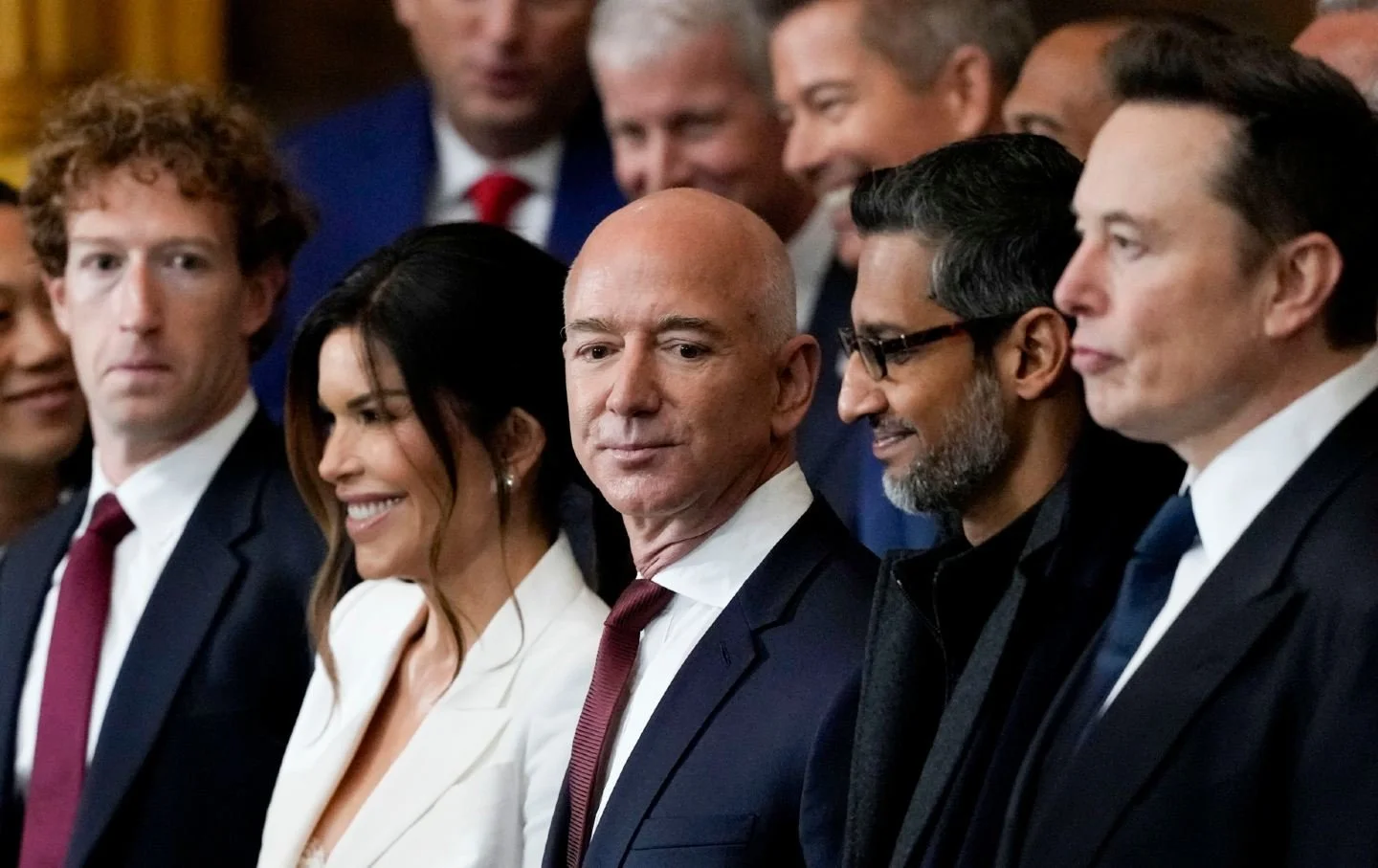
Trump’s inauguration was a who’s who of Silicon Valley.
Meanwhile, AI companies are cashing in on the very chaos they’ve helped create. At Donald Trump’s inauguration in early 2025, he was flanked by the heads of virtually every major tech company after Silicon Valley donated almost $400 million towards getting him reelected (and likely much more indirectly). Each CEO then ‘donated’ an extra $1 million for front row seats, ahead of members of congress and proposed members of his own cabinet. Then Trump immediately went to work slashing AI regulations, removing safety guardrails, weakening or waiving environmental protections, and announcing the $500 billion ‘Stargate’ project that will consume unprecedented amounts of electricity and water. The fact that AI has caused to much unbridled chaos is a feature, not a bug, and if the likes of Musk, Pichai, Bezos, Altman, Thiel, and Zuckerberg have to choose between society’s well-being and trillions of dollars, well, I think we all know how that goes.
The funny thing is that, at least theoretically, AI could be the greatest fact-checking machine the world has ever seen. Wherever people spread misinformation, bot swarms run rampant, or bad actors create fake pages and profiles, AI could be there to call it out and provide the actual facts, like community notes in God mode. But, as we all know, misinformation is thriving, social media platforms are becoming fascist playgrounds and harrowing echo chambers of climate change denial, and a lot of us – often knowingly – are simply becoming a bit numb to it all.
No, AI won't fix climate change. In fact, it’ll likely make it far worse
A common line trotted out by AI’s biggest proponents – without any evidence, mind you, because there isn’t any – is that AI will ‘solve’ global warming and climate change, and therefore it demands everyone’s unbridled support. This claim is essentially just the tech-bro equivalent of 80s trickle-down economics: if we just give more money, tax breaks, and precious resources to the already-mega-wealthy companies building AI, the technology will become so powerful and effective that it won’t be able to help but solve our species’ most critical challenge along the way.
After all, now that Elon Musk is a trillionaire, some of that money is bound to wind up in your pocket, right? Right?
The reality is, to the surprise of nobody paying attention, quite the opposite. As a prime example, you may have heard about the colossal data centre project approved in Utah, spearheaded by the bombastic (not a compliment, BTW) Kevin O’Leary of Shark Tank fame. It will use up to 9 GW of electricity – more than double the state’s existing power demand – and it will be generated entirely by natural gas. This project is emblematic of AI’s rapid swing to off-grid fossil fuels, as increasingly large data centre projects seek to secure far more electricity than many grids can currently provide. In the US alone, there are reportedly plans for 74 new or expanded natural gas plants exclusively to power AI data centres, which will produce as many carbon emissions as Australia.
Even for a writer like me who specialises in renewable energy, sustainability, and the environment, it’s almost impossible to articulate just how catastrophic these projects are for the health of our planet. They consume vast amounts of land, use gigantic volumes of electricity and fresh water (which many facility owners buy for next to nothing while pushing up prices for everyone else), generate very few local jobs, and can create relentless noise pollution – and that’s not to mention the embodied energy and carbon emissions of their construction, computer servers, and cooling systems.
The truth is that many of the remarkable gains renewable energy has made over the last 15 years now risk being steamrolled by the aggressive expansion of hyperscale data centres. The International Energy Agency projects that AI's cumulative power demand will hit 1,000 terawatt-hours in 2026 – equal to that of Japan, one of the world’s most advanced economies and home to 122 million people.
It’s little wonder that many communities worldwide are vehemently pushing back against new data centre developments, particularly when they increasingly view AI as something that will make their lives demonstrably worse, not better.
As someone who writes about climate change and global warming for a living, using AI in my work would feel downright hypocritical. If you’re like me and would like to decarbonise your web activity, you can fund tree-planting programs worldwide by using the Ecosia search engine, which now allows you to disable its AI functionality entirely.
In simple terms: it’s about principles
I’ve covered many of the different reasons why I don't (and won’t) use AI in my writing work, but ultimately, it’s about principles.
There’s a legendary Australian movie called ‘The Castle’ (as in, ‘a man’s house is his castle’), in which Aussie battler Darryl Kerrigan finds out his family home is being compulsorily acquired by a nearby airport. His initial pushback leads the buying group to raise its offer by $25,000 (an increase of 35% and lot a of cheese back in 1997!), but Darryl flatly rejects this as well, leaving his two sons mystified as to why he won’t just take the money.
Then Darryl’s adoring wife Sal tells a little story about a night at the greyhounds that illustrates why she loves him so much:

Darryl and Sal Kerrigan: two dead-set Aussie legends.
‘...and this young fella, he comes right up to me and starts chatting to me and…and he asks me out. And I said, “Well, I'm on a date.”
Well, he backed right off. He said he wasn't cutting anyone's lunch, and he wished me good night.
And I thought, ‘That man has principles.’ And from that day on, I've only had eyes for one man. And that's what I love about him: his principles. So we’re not taking the money.’
It’s such a wholesome scene with a, dare I say it, refreshingly old-fashioned message.
Principles. If we don’t have principles, what do we have? If we continuously yield to our immediate impulses, and if we unconsciously train ourselves to take the easier route at the expense of our own intelligence, employment, and even welfare, what is it we’re gaining, exactly?
Despite everything I've said in this article, I’m actually not against AI, at least in theory. Obviously, if it has the potential to genuinely improve human health and well-being, such as by contributing to medical research, optimising transport, and accelerating the growth of clean energy – and if it can further these aims without compromising them in the process – then that’s a great thing. However, to date, AI has been developed in some of the most illegal, unethical, and environmentally destructive ways possible, all the while enriching and empowering a tiny cabal of the most narcissistic and insufferable people imaginable, accelerating the enshittification of the entire internet (likely beyond repair), eroding social stability, and trying to supplant every creative person who’s ever earned a living from the power of their grey matter.
So that’s why I don’t use AI to write – and never will. My work is the product of human knowledge, emotions, and experiences, and whenever someone reads it, I hope they feel that intrinsic connection with the real person at the other end.
Looking for a passionate human writer with 10+ years of experience in renewable energy and sustainability?
Just fill in the form below.